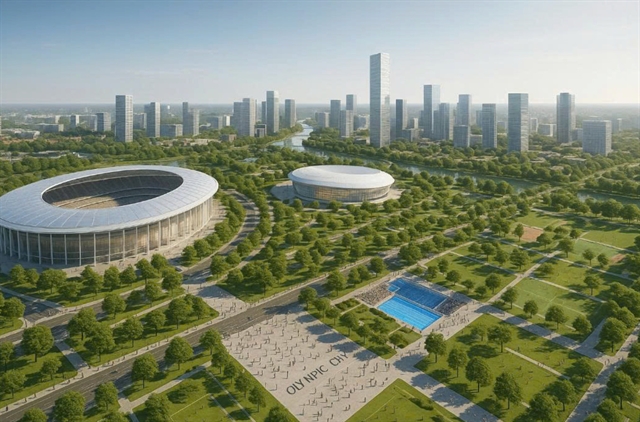
The Hanoi People’s Committee has reportedly given its initial approval for a monumental project: the development of a world-class Olympic sports urban area within the heart of Vietnam’s capital. The ambitious plan, which was announced on November 11, 2025, aims to establish a state-of-the-art complex capable of hosting major international sporting events.
This prospective sports city is envisioned to dwarf many existing international sports complexes globally. The total land designated for research and development for the Hanoi Olympic Sports Urban Area spans approximately 16,080 hectares. A significant portion, Section A alone, covers an expansive area of about 3,280 hectares. The project’s detailed planning horizon extends to 2045, with a broader strategic vision set for 2065.
The sheer scale of Hanoi’s proposed sports city stands out remarkably when compared to other notable sports urban areas worldwide. For context, it is nearly 1/20th of Hanoi’s entire landmass, which totals 335,900 hectares. In contrast, Australia’s iconic Sydney Olympic Park occupies 640 hectares, Dubai Sports City in the United Arab Emirates covers 464 hectares, and Qatar’s Aspire Zone in Doha is a more modest 250 hectares.
Beyond its impressive size, the comprehensive plan outlines the construction of multiple world-class stadiums designed to accommodate major global sporting competitions. Furthermore, the development will include advanced swimming facilities and dedicated provisions for an international athletes’ village, ensuring top-tier amenities for participants.
This approved initiative aligns strategically with the Vietnamese National Assembly’s resolution on the National Master Plan for 2021-2030, which includes a long-term vision stretching to 2050. The primary objective of the project is to forge a new urban center in Southern Hanoi, concentrating on the synergy between sports, tourism, and ecological services. It also seeks to establish a comprehensive sports hub and an Olympic village that not only meets but exceeds regional and international benchmarks, thereby positioning Hanoi as a prime candidate for hosting prestigious events such as the Asian Games and the Olympic Games.
Moreover, the extensive planning is expected to spur spatial expansion in Southern Hanoi, fostering seamless integration between social and technical infrastructure across both urban and rural landscapes. This forward-thinking initiative aims to cultivate a modern, intelligent, and efficiently designed city that will also serve as a crucial transportation nexus, significantly boosting the socio-economic development of Hanoi’s southern gateway region, which currently serves a population exceeding 8.8 million residents.