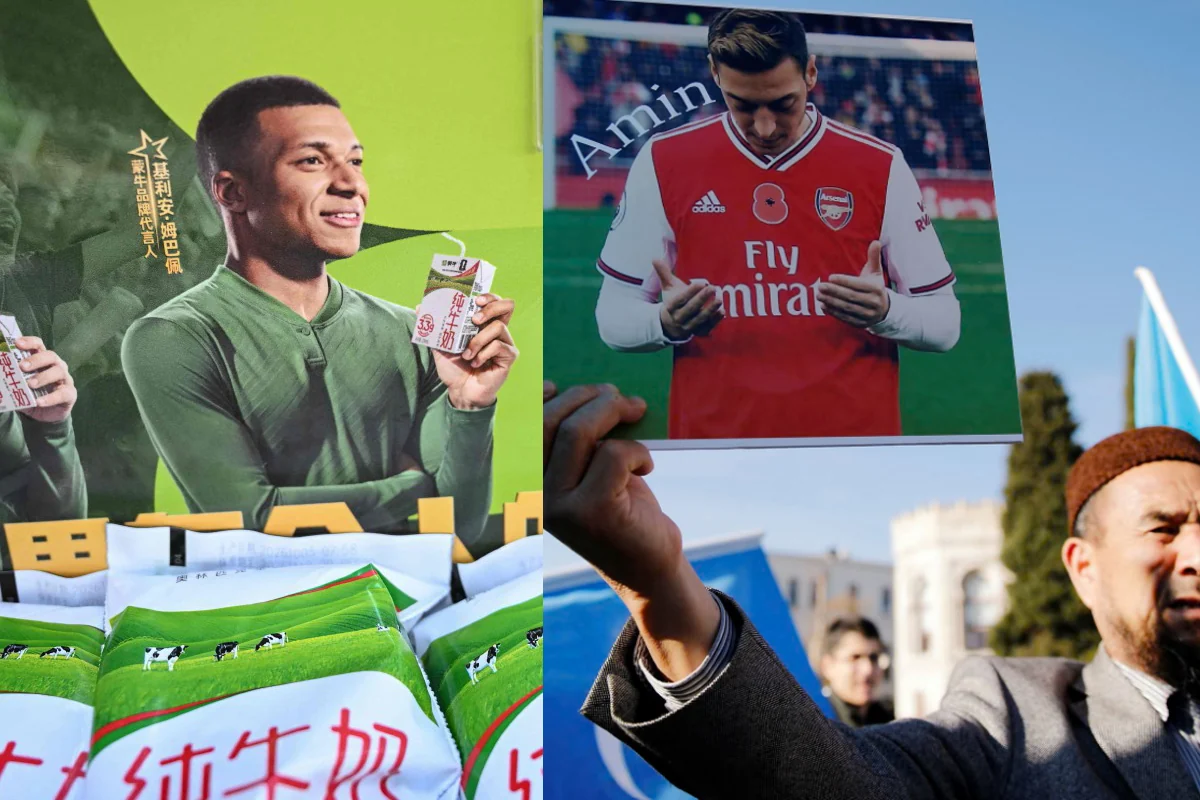
Kylian Mbappé and Mesut Özil, two of football’s most globally recognized stars, have each found themselves embroiled in controversies involving China. While both situations share a superficial similarity – a clash with Chinese sensitivities – a deeper examination reveals vastly different underlying causes, circumstances, and, crucially, levels of impact and repercussions.
Mesut Özil’s conflict with China, which first erupted in December 2019, stemmed from a grave political and human rights dispute. At the time, while playing for English Premier League club Arsenal, the former German international utilized social media platforms to critically address China’s policies and actions concerning the Uyghur Muslim minority in the Xinjiang region. He specifically accused the Chinese government of human rights abuses and the suppression of religious freedom within the autonomous region.
This highly charged statement from the former Real Madrid midfielder provoked a furious and widespread response from the Chinese government, local football clubs, and a vast segment of Chinese fans. The repercussions for Özil were immediate and severe: his name and profile were systematically erased from Chinese online games and domestic media platforms. State broadcaster CCTV completely removed live broadcasts of Arsenal’s matches, signaling a strong official condemnation. Arsenal, acutely aware of its significant commercial interests and fanbase in China, publicly distanced itself from Özil’s comments, affirming that the club was not associated with his personal opinions. Following this escalating controversy, Özil’s playing time with the Gunners was significantly reduced, a situation that ultimately led to his departure from the English club in 2021 to join Fenerbahçe in Turkey’s top flight. In essence, Özil’s outspoken remarks effectively cost him his entire market presence in China, having crossed what is widely considered a critical political ‘red line’ by Beijing concerning human rights in Xinjiang. This incident also dealt a considerable blow to Arsenal’s extensive fanbase and commercial interests within the Chinese market.
In stark contrast, the recent situation involving French captain Kylian Mbappé appears to be far less severe than Özil’s politically charged incident. Mbappé reportedly made a lighthearted comment, referring to Mao Zedong, the founding father of communist China, as a ‘dictator.’ While this remark did elicit a backlash, the reactions directed at the forward, widely associated with Real Madrid, have largely been confined to social media platforms, primarily from individual fans, alongside general public criticism rather than official government condemnation.
Crucially, Mbappé’s situation has not escalated to the same level of nationwide sanctions or official bans that Özil experienced. The potential impact on the 27-year-old player is likely limited to a possible decrease in his popularity among some Chinese fans. His relationship with his current club, Paris Saint-Germain, and his prospective future team, Real Madrid, as well as his on-field appearances, are not expected to be significantly affected. Mbappé’s comment, pertaining to an opinion on a historical figure and a past revolutionary leader, while causing displeasure among some Chinese citizens, has not been met with the same depth of official political response or widespread condemnation as Özil’s direct criticism of contemporary government policy. Furthermore, reports indicate that the player himself, La Liga, and the club Real Madrid have all issued official apologies, a proactive step that may help to de-escalate tensions within the Chinese community globally.
The contrasting experiences of Mesut Özil and Kylian Mbappé in China highlight the nuanced and often unpredictable nature of public discourse involving international sports figures and geopolitical sensitivities. While both faced criticism, the fundamental differences in the underlying issues—explicit accusations of human rights violations versus a comment on a historical figure—dictated fundamentally divergent outcomes and levels of career impact.