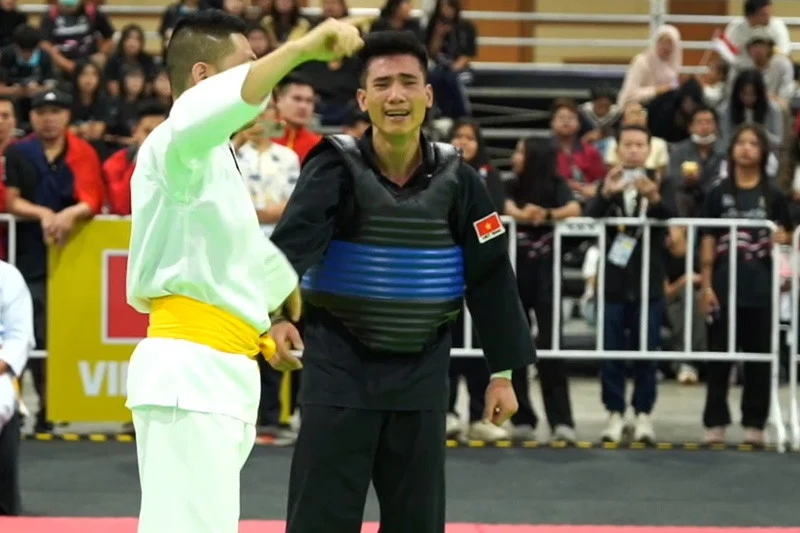
The 33rd Southeast Asian Games (SEA Games) Pencak Silat competition has been plagued by significant controversy, drawing strong criticism from both Vietnam and Malaysia regarding alleged referee bias. Vietnamese Pencak Silat athlete Vu Van Kien was visibly distraught, reduced to tears after being disqualified from his men’s 60kg semi-final bout. His disqualification stemmed from a contentious incident where his kick, intended for his Thai opponent, landed on the opponent’s face after the Thai athlete reportedly ducked, leading to a foul under the strict rules prohibiting face contact. This contentious decision, which ultimately led to Kien’s elimination, has fueled widespread frustration and echoes similar sentiments previously expressed by the Malaysian delegation regarding officiating perceived as favoring the host nation, Thailand.
The incident involving Vu Van Kien occurred on December 17. Kien had been dominating his Thai opponent, leading significantly with a score of 52-34 and appearing to be on a clear path to the gold medal match, showcasing excellent technique throughout the bout. However, with only four seconds remaining in the match, Kien executed a kick. Tragically for him, his Thai opponent unexpectedly ducked, causing Kien’s foot to strike the opponent’s face. Immediately following this, the Thai athlete collapsed to the mat, reportedly in distress. Medical personnel promptly attended to the athlete, and after a seven-minute delay for assessment, the referee ultimately awarded the victory to the Thai competitor, citing a violation of the rules. In Pencak Silat, contact to the face is strictly prohibited and is considered a severe foul.
This outcome was deeply disappointing for Kien, who, instead of advancing to the gold medal round, was relegated to compete for a bronze medal. Overwhelmed by the loss of his opportunity for gold, Kien was visibly emotional and tearful, expressing profound dissatisfaction with the referee’s decision. His coach, Mr. Nguyen Van Hung, publicly accused the Thai athlete of employing deceptive tactics and feigning injury to exploit the rules, thereby unfairly influencing the match’s outcome.
Further intensifying the controversy surrounding the Pencak Silat competition, another contentious incident affected a Vietnamese athlete in the men’s 65kg category. Nguyen Minh Triet faced a Malaysian opponent and, similarly to Kien’s incident, was struck by a kick to the neck. Despite protests from the Vietnamese coaching staff and medical personnel examining Triet, the referee instructed Triet to continue the match. Ultimately, the victory was awarded to the Malaysian athlete based on accumulated points, a decision that again drew sharp criticism from the Vietnamese delegation regarding perceived officiating inconsistencies.
These incidents followed an earlier scandal on December 16, when the Malaysian team was involved in a physical altercation with referees. This confrontation reportedly erupted after officials awarded a victory to a Thai host athlete in the women’s 50-55kg category, despite the match ending in a 60-60 tie. The Malaysian delegation vehemently protested this decision, asserting that the refereeing displayed clear favoritism towards the host nation.
The cumulative effect of these controversial decisions and alleged biases has led to mounting criticism against host nation Thailand. Accusations of “stealing medals” and a lack of fair play have cast a shadow over the Pencak Silat competition, significantly impacting the reputation and integrity of this regional Southeast Asian sporting event.