
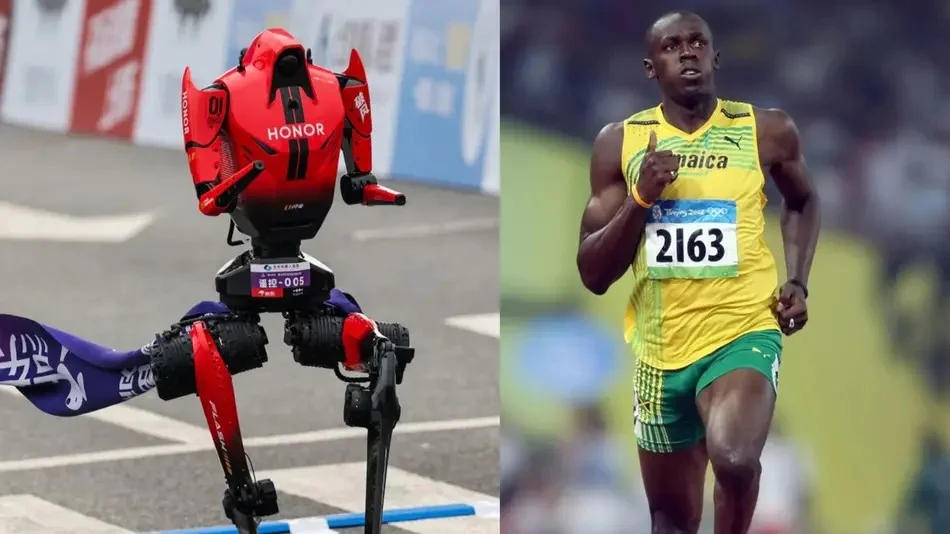
In a remarkable display of technological advancement, a Chinese humanoid robot has achieved an astonishing feat, completing a 100-meter sprint in an extraordinary time of just 9.39 seconds. This groundbreaking performance took place during the preliminary rounds of the 2026 World Humanoid Robot Games in Beijing, where the robot’s speed officially surpassed the long-standing world record held by legendary sprinter Usain Bolt.
Organizers of the event confirmed that the Tiangong Ultra robot, developed by the Beijing Humanoid Robot Innovation Center, secured victory in its qualifying heat. This impressive win occurred on August 22, during the opening ceremony of the second season of the prestigious robot games.
The Tiangong Ultra demonstrated incredible resilience, overcoming an initial deficit to ultimately outpace its competitor, the Lightning robot, developed by mobile phone manufacturer Honor. Lightning completed the 100-meter dash in a commendable 9.47 seconds. However, Tiangong Ultra’s blistering time of 9.39 seconds was notably faster than Usain Bolt’s human world record of 9.58 seconds. The retired Jamaican athlete set this iconic benchmark for the men’s 100-meter sprint at the 2009 World Athletics Championships in Berlin, Germany.
Despite their impressive performance, both robots sustained damage after crossing the finish line. The immense speed at which they collided with the thick safety mats, specifically designed to absorb impact and halt their momentum, proved too forceful, resulting in structural damage to the advanced machines.
The results from this second season of the games highlight a rapid pace of development in humanoid robotics. This marks a significant improvement from the inaugural season last year, where the Tiangong Ultra completed the 100-meter dash in a much slower 21.50 seconds. Furthermore, Tiangong had previously demonstrated its endurance capabilities by winning the world’s first humanoid robot half-marathon, also held in Beijing, in 2025.
The 100-meter sprint is just one of 51 diverse events featured at the World Humanoid Robot Games. The competition showcases a wide range of robotic capabilities, including football matches, elaborate dance performances, boxing bouts, and various industrial task simulations, demonstrating the versatility of these advanced machines.
This year’s competition, held at the National Speed Skating Oval, saw an unprecedented scale of participation. A total of 2,056 robots, representing 666 teams from 16 countries across six continents, vied for supremacy. This marks a substantial increase in participation compared to previous editions, which featured only 280 teams, underscoring the growing global interest in humanoid robotics.
China has strategically identified the robotics industry as a key sector for national development and innovation. The nation has actively promoted and championed the advancement of humanoid robotics, with policymakers and leading companies firmly believing that breakthroughs in AI technology and component manufacturing will accelerate the widespread integration of robots across various sectors, including manufacturing, logistics, and diverse consumer applications.
The burgeoning interest and investment in this sector have already yielded significant economic impacts. For instance, the shares of Unitree, one of China’s most prominent robotics manufacturers, surged more than fivefold during its initial public offering in Shanghai, pushing its market valuation to approximately $50 billion.